
Scientific Research
IIM-CSIC is a center with an outstanding track record in marine research, built on a multidisciplinary vision that makes it a unique benchmark by bringing together research areas as diverse as oceanography, marine biodiversity, aquaculture, socioeconomics and food technology. Its mission is to generate scientific and technological knowledge that contributes to the sustainable use of marine and coastal resources, improves food safety and human health, and promotes the socio-ecological resilience of the marine environment.
This convergence of disciplines not only broadens the comprehensive understanding of the marine environment, but also enables the generation of innovative solutions that can be applied to real challenges and problems along the entire marine value chain.

Ocean and Global Change
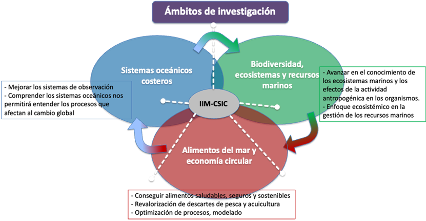
This area focuses on the observation, monitoring and modeling of ocean systems and coastal ecosystems. Multiscale observation platforms are being developed that integrate physical, chemical and biological data which, combined with predictive modeling, artificial intelligence and data science, improve the capacity to analyze, predict and manage global change in the ocean and in coastal environments.
It analyzes the impact of global change and human activity on the ocean, including processes such as warming, acidification, pollution and biogeochemical changes.
Biodiversity, Ecosystems and Marine Resources
This area addresses the study of biodiversity and the functioning of marine ecosystems, as well as the effects of climate change and pollution on their structure and services. Approaches from ecology, genetics, physiology, microbiology and evolutionary biology are integrated to analyze ecosystem resilience and the health of species and populations. It also includes research in sustainable aquaculture, animal health and welfare, under a One Health approach that connects environmental, animal and human health.


Seafood and Circular Economy
This area focuses on the sustainable transformation of marine resources along the sea-industry-consumption chain. It includes biomass valorization, the development of bioingredients, food safety and traceability, assessment of nutritional and environmental impact, and innovation in processing technologies. The circular economy is promoted through the use of by-products and the generation of new high-added-value products.