

- This event has passed.
5th General Assembly of the Marine Sciences Programme
The Marine Sciences Programme of Galicia
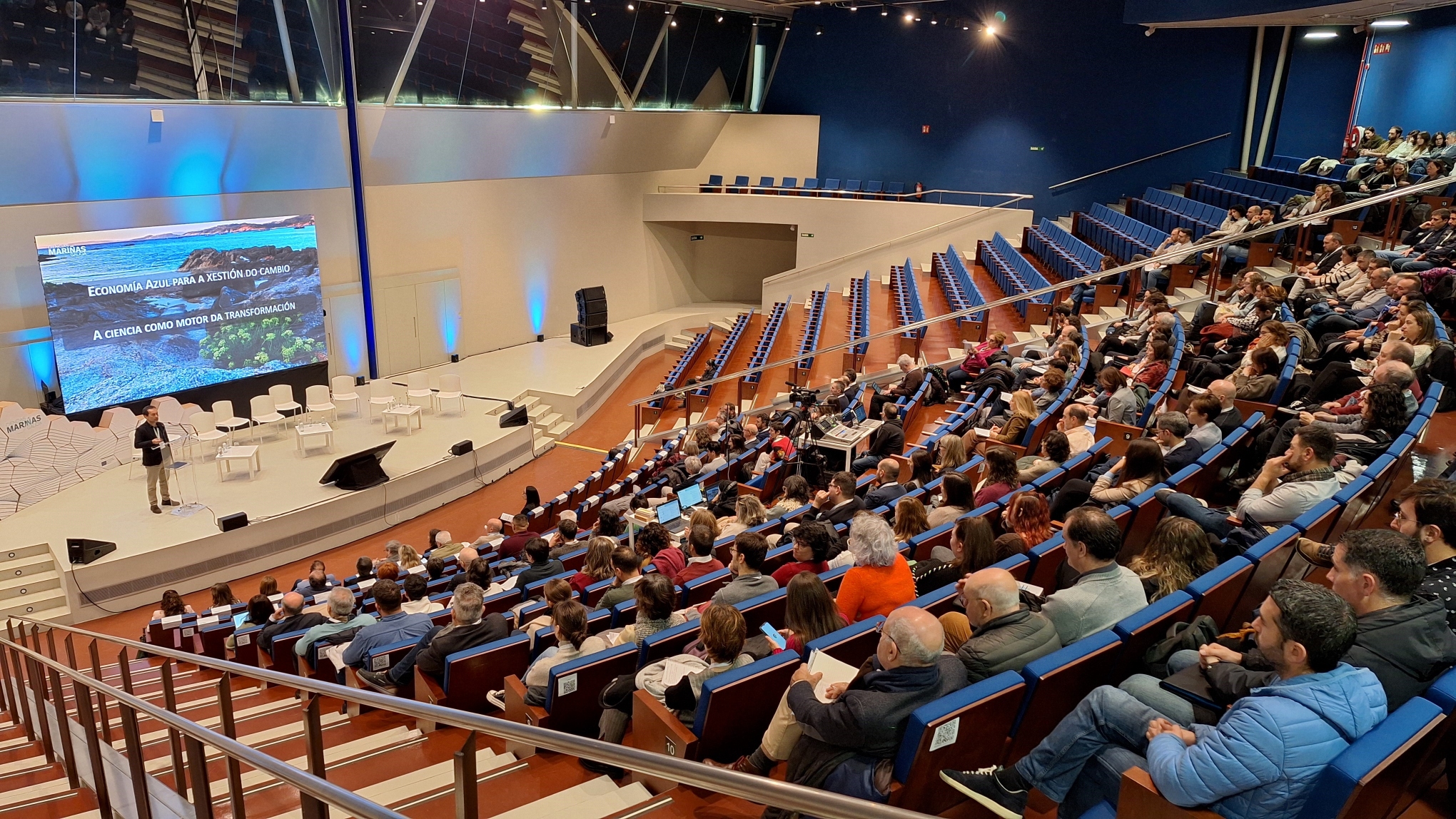
Santiago de Compostela, 13 December 2024 – This Friday, 13 December, the Cidade da Cultura became the epicentre of marine research and innovation in Galicia. The event brought together around 200 participants, including researchers and representatives of public administrations, productive sectors and organisations from the marine world, to assess progress and discuss the present and future challenges of science and research in these fields in Galicia.
Under the title “Progress in response to identified challenges and meeting with the marine sectors”, the day was opened by Javier Alfonso Villares, Regional Minister for the Sea of the Xunta de Galicia, after a welcome to attendees by J. Francisco Saborido Rey, scientific coordinator of the Programme and IIM-CSIC researcher. Conceived as a space for dialogue and collaboration around the needs and challenges of Galicia’s marine sector to which research can respond, this Assembly highlighted progress in marine observation and monitoring, sustainable aquaculture and social and economic transformation. Throughout the day, experts offered lectures, round tables and thematic panels in which the challenges and achievements reached so far by the participating entities were discussed.
The presentations highlighted advances in research on new observation platforms and technologies to obtain more and better data on the state of the marine environment, the changes occurring in it and their impact. Advances in knowledge of the state of resources and technologies for improving aquaculture, shellfishing and fisheries production were also addressed. The final session focused on the importance of connecting this research with socio-economic studies, as well as its relevance for the development of the main public policies for the marine sectors.
Several innovative initiatives were presented, including new integrated observation platforms, progress in strategies and planning for the use of these tools, a marine virtual laboratory and extreme-event simulators, digitalisation in fisheries value chains, the application of genomic tools to improve aquaculture and shellfishing production, and progress in the sustainable management and supply of mollusc seed. In addition to technological innovations, the Programme also presented advances in knowledge and socio-economic analysis techniques that will help to better understand the extent to which human activities are affected by environmental change. It also addressed how new regulatory instruments and public strategies — Blue Economy, Climate Change and the Galician Coastal Planning and Integrated Management Act — can improve their effectiveness by making use of the full range of technologies and knowledge emerging from this Marine Sciences Programme.
A commitment to innovation and sustainability
The meeting focused on three thematic blocks that reflected the importance of innovation in key areas such as marine observation and monitoring, sustainable use of resources and the resilience of coastal ecosystems.
The first session addressed technological challenges towards integrated and sustainable marine observation. Progress on observation networks was presented, highlighting developments such as new biogeochemical platforms, the automation of ecotoxicological bioassays and the use of drones with artificial intelligence to monitor intertidal macroalgae. Innovative tools and services were also presented, including a marine virtual laboratory and the development of digital twins. The needs of sectors related to fisheries, renewable energies and sustainability were also analysed, concluding with a debate on shared challenges and priorities.
The second part of the meeting addressed sustainable fisheries, shellfishing and aquaculture, with innovation as one of the fundamental pillars for ensuring the viability of the sector in the coming years.
Different approaches and technologies for ensuring sustainability in fisheries were discussed, including the use of genomics in resource management, end-to-end models for key species, digitalisation in the value chain and sustainability analysis from a socio-economic perspective. Innovative solutions were also presented, such as the application of artificial intelligence to improve industrial processes. The session closed with a debate on these challenges and opportunities for fisheries sustainability.
The second round table presented advances in innovation to improve sustainability and efficiency in aquaculture. Topics included improving the health conditions of production, new methodologies for assessing animal welfare, innovation in sustainable feed, genomic tools and systems for diversifying aquaculture production systems. Sector representatives also shared practical experiences on the transformation currently taking place in these areas.
The third round table focused on how to strengthen resilience in shellfishing and mussel farming. Tools were presented such as prediction systems for environmental alerts affecting culture conditions, the production of disease-resistant seed, cryopreservation of mollusc larvae and seed to reduce seasonality in production, and models for assessing population parameters. The importance of sustainability in Galician mussel farming and shellfishing was also highlighted, closing with a debate with the affected sectors on the solutions presented.
Knowledge of coastal ecosystems and the future of the marine economy
The final session was dedicated to sustainable and resilient management of the marine environment and highlighted the role of the Marine Sciences Programme of Galicia in providing knowledge and information for informed decision-making, the development of an effective regulatory framework and public strategies related to the marine environment. Essential issues were discussed, such as integrated management of the Galician coast and the opportunities arising from new legislation, as well as Galicia’s blue economy and climate change strategies. The session also addressed systems for quantifying and analysing the interrelationship of activities within the sea-industry complex in coastal areas, integrated environmental indicators such as the Ocean Health Index, the importance and mechanisms for estimating the value and balance of blue carbon and recreational services, and the effects of climate change on the vulnerability of the fisheries and shellfishing sector. The session concluded by discussing the extent to which a truly comprehensive and integrated marine observation strategy is a key tool for understanding coastal and marine ecosystems and improving the management of human activities in relation to them.
Across the whole day, the people responsible for moderating and guiding the presentations placed special emphasis on developing, in parallel and as a complement to the research, new strategies to achieve transformative knowledge transfer, aimed primarily at improving the capacity of the system and of citizens to make greater and better use of scientific advances for the benefit of society as a whole.
The meeting served as a space for the research community of Galician public institutions, the private sector and administration representatives to share their points of view and express their intention to maintain dialogue and expand opportunities for collaboration. All this was based on the shared understanding that such collaboration is essential to address common challenges related to the sustainability and management of marine resources.
Collaboration between research entities and the business sector
The meeting, organised by the Institute of Marine Research, Spanish National Research Council (IIM-CSIC), the Marine Technology Centre, CETMAR Foundation and the University of Vigo (UVigo), also included the participation of all institutions and research centres that form part of the Programme: the University of Santiago de Compostela (USC), the University of A Coruña (UdC), the Galician Supercomputing Centre (CESGA), the Technological Institute for the Control of the Marine Environment of Galicia (INTECMAR), Meteogalicia, the Spanish Institute of Oceanography (IEO-CSIC) and the centres belonging to the Regional Ministry of the Sea, the Marine Research Centre (CIMA) and the Galician Institute for Aquaculture Training (IGAFA), together with companies and organisations promoting innovation in the marine sectors.
The Marine Sciences Programme of Galicia has a budget of 10 million euros and is funded by the Ministry of Science and Innovation through the Recovery, Transformation and Resilience Plan with Next Generation EU funds, and by the European Maritime, Fisheries and Aquaculture Fund through the Regional Ministry of the Sea of the Xunta de Galicia. The Programme forms part of the national Complementary Marine Sciences Plan, in which, in addition to Galicia, the Autonomous Communities of Murcia, Andalusia, Valencia, Cantabria, the Balearic Islands and the Canary Islands also participate.
The progress and results achieved in the Marine Sciences Programme of Galicia represent a step forward in improving research and innovation in the sector, consolidating Galicia as a benchmark in marine sciences and strengthening its capacity to face the environmental, social and economic challenges of the future.
