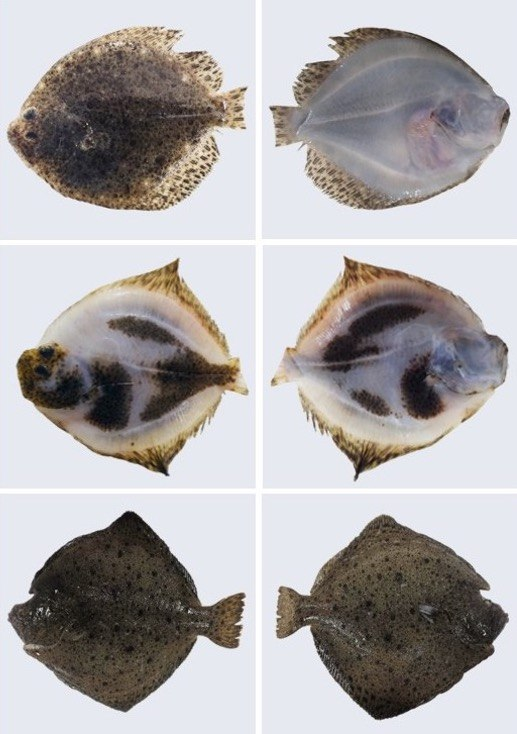


The study, carried out by the Aquatic Biotechnology Laboratory, establishes for the first time a genomic framework for malpigmentation in this species and opens up new avenues for the genetic improvement of turbot.
The Institute of Marine Research (IIM-CSIC), through its Aquatic Biotechnology Laboratory, has identified the genes and regions of the genome associated with pigmentation defects that occur in turbot (Scophthalmus maximus) reared in aquaculture conditions. These abnormalities can significantly reduce the commercial value of the affected fish, although they do not affect the quality of the product.
This work constitutes the first comprehensive study of the genetic architecture of malpigmentation in turbot and establishes an initial genomic framework for understanding the basis of these disorders. The results also provide markers with potential for practical application and a solid basis for developing future genomic selection strategies, aimed at reducing the incidence of these abnormalities and improving product uniformity and the economic sustainability of production.
The research was carried out as part of the HOLOFISHCOLOUR project, “A hologenomic approach to elucidating pigmentation disorders in captive-reared flatfish species”, funded by the State Research Agency (AEI) of the Ministry of Science, Innovation and Universities, via project PID2021-1236511OB-100, with NextGenerationEU/PRTR funding. The study also involved the Neurolam group at the University of Vigo (UVigo) and the Pescanova Biomarine Centre.
A common abnormality in farmed turbot
Turbot is one of the flatfish species of greatest commercial importance for aquaculture. During its development, it undergoes a metamorphosis in which it changes from a bilaterally symmetrical larva to a dorsoventrally flattened juvenile adapted to benthic life, a process accompanied by significant changes in its pigmentation pattern.
Under farming conditions, abnormalities in this pattern may occur, including pseudo-albinism on the eyed side and hypermelanosis on the blind side. The incidence of these disorders can exceed 70 per cent of juveniles reared in aquaculture, and although they do not affect the quality of the fish, they can reduce its commercial value.
“The mechanisms responsible remain unclear, but it is believed that pigmentation disorders arise from the interaction of genetic, physiological and environmental factors,” explains Josep Rotllant (IIM-CSIC), who is in charge of the project under which the study was carried out.
Until now, various studies had pointed to the influence of environmental factors such as diet, lighting or certain hormonal changes during metamorphosis. However, the role of genetics in these disorders had not been characterised in depth.
More than 1.68 million genetic variants analysed
To gain a deeper understanding of the genetic basis of pigmentation abnormalities, the research team analysed 785 specimens from ten different families and studied more than 1.68 million genetic variants. The research enabled the identification of specific regions of the genome linked to the occurrence of these defects, particularly on chromosomes 5 and 15.
In these regions, genes and pathways related to processes such as melanocyte formation, melanin synthesis and the embryonic development of pigmentation were identified. Genomic analyses also revealed a significant genetic component in the predisposition to develop these abnormalities.
“The predisposition to develop these abnormalities has a significant genetic component, which opens the door to selecting broodstock less likely to pass this trait on to their offspring,” explains María Saura (IIM-CSIC). The researcher emphasises that the results show that, alongside already known environmental factors, genetics plays a decisive role in the onset of these disorders.
Scientific knowledge to improve aquaculture
The findings open up new possibilities for the development of genetic selection programmes capable of reducing the incidence of pigmentation defects without the need to alter current production systems.
The identification of genetic markers associated with these abnormalities will pave the way for the development of tools that can be incorporated into future turbot breeding programmes. Their application could help to improve product consistency, the efficiency of production systems and the profitability of farms, thereby reducing the economic impact associated with these defects.
“This work represents a paradigm shift in our understanding of turbot pigmentation, as it provides, for the first time, genomic tools that can be directly incorporated into the genetic improvement programmes used by the industry,” explain Josep Rotllant and María Saura (IIM-CSIC). The researchers point out, however, that further studies will be needed to confirm the specific function of some of the identified genes.
The study thus represents a step forward both in our understanding of the genetic mechanisms involved in turbot pigmentation and in its potential applications for the sector. The development of these markers and their future transfer to genetic improvement programmes strengthen the link between research, innovation and production, and demonstrate the potential of aquatic biotechnology to contribute to a more efficient, competitive and sustainable aquaculture sector.
In this regard, the work carried out by the IIM-CSIC’s Aquatic Biotechnology Laboratory demonstrates how knowledge generated through basic research can be translated into practical tools for the sector and contribute to improving production processes and the economic sustainability of aquaculture.
Scientific reference: Genetic architecture and genomic regions associated with malpigmentation in farmed turbot (Scophthalmus maximus). Aquaculture 626 (2027) 744393.