


Written by Marta López Mozos, predoctoral researcher in Ocean Processes in Global Change (collab.: Jaime Amaro Blanco).
[Article from the initiative Lanterns of Science, produced by the IIM-CSIC and published today in Faro de Vigo]
You have surely heard that the planet’s temperature is rising. Terms such as climate change, global warming and the greenhouse effect have been part of everyday life for years. Although it may seem strange, the scientific community did not know these terms until a little over a century ago. In fact, the beginning or origin of the knowledge we currently have about climate was the work of a nineteenth-century suffragist and scientist whose profile, like that of many others, remained in the shadow of later discoveries made, in this case, by male scientific colleagues.
The first evidence of what we now know as the greenhouse effect came from the scientist and suffragist Eunice Newton Foote (1819-1888) in 1856. Foote was born in a small town in Connecticut, in the United States, but moved during her childhood to New York, where she had the opportunity to receive an education that was progressive for its time. In 1841 she married the lawyer and mathematician Elisha Foote, with whom she would actively take part in some of the most important scientific and social movements of her time.
The nineteenth century was a thrilling period in which what had until then been known as “natural philosophy” became professionalised and began to be called “science”. Driven by a genuine interest in understanding the world around them, the Newton-Foote couple set up their own amateur laboratory at home, where Eunice carried out numerous experiments.
In one of them, using a simple but ingenious methodology, Foote isolated common air and carbon dioxide (CO2) and measured the temperature of the containers holding them when exposed to sunlight. After some time under the sun’s rays, she observed that the container with the higher amount of CO2 was warmer. This temperature difference between containers allowed her to conclude that “an atmosphere of CO2 could give our Earth a high temperature”. She carried out the same procedure isolating dry and moist air, and was able to observe and state that humidity also favoured greater warming. In this way, the researcher revealed for the first time the importance of water vapour and CO2 in climate, although this did not prevent her discovery from going unnoticed for more than a century.
Under the title Circumstances Affecting the Heat of Sun’s Rays, Foote’s work was presented at the Eighth Annual Meeting of the American Association for the Advancement of Science (AAAS) in Albany, New York, in 1856. However, despite being the author of the project, the ban on women attending the AAAS meant that her work was presented by Professor Joseph Henry, who found Foote’s discovery highly interesting. Neither the research nor the presentation were included in the conference proceedings.
Her work was, however, published in the American Journal of Science in 1857, although the manuscript was only recovered more than 150 years later, in 2016, by climatologist Katharine Hayhoe, prompted by scientist and collector of scientific manuals Raymond P. Sorenson. In fact, the merit of Foote’s discovery was for years attributed to the scientist John Tyndall, who appears in history as the first to speak of the greenhouse effect in 1859, three years after Foote. Years later, Svante Arrhenius was also highlighted as a precursor of knowledge about climate change, while Eunice’s figure remained unrecognised.
It is still unknown whether Tyndall was aware of Foote’s research when he published his discovery, since communication between the American and European academies was much more costly at that time than it is today. What is certain is that neither he nor many others cited the work of their predecessor. As Roland Jackson, scientist and historian of the Royal Institution, has pointed out, in addition to the disadvantage of belonging to the American academy rather than the European one, Foote had two factors working against her: her gender and her status as an amateur, the latter a product of the former.
In addition to her belatedly recognised and talented research spirit, Foote was a recognised figure in the early contemporary feminist movements. The many political and social restrictions faced by women in the nineteenth century crystallised in movements such as suffragism. During the 1840s, several women in the United States, including our protagonist, organised to denounce their situation: the lack of voting rights, their lack of access to higher education, the impossibility of holding public office or the transfer of their property to their husbands after marriage, which prevented them from having property of their own. Foote was a prominent person in this movement, appearing as a member of the Editorial Committee of the historic Seneca Falls Convention, the first convention for women’s rights, and as one of the 67 women who signed the resulting Declaration.
Women’s suffrage did not arrive in the United States until 1920. Even so, Foote’s political and scientific struggle, and that of many other women, contributed decisively to the reality in which we live today, not only as a society moving towards equality, but also as a society seeking global solutions to a serious climate crisis.
Almost thirty years ago, different world leaders came together to collectively address the problem of climate change for the first time. Almost a century and a half earlier, Foote had already advanced the scientific basis for one of the proposals of the Kyoto Protocol (1997): reducing greenhouse gas emissions (mainly CO2) to mitigate the evident rise in Earth’s temperature by reducing activities such as the burning of coal, oil and natural gas, as well as other large-scale economic activities such as livestock farming and deforestation.
Greenhouse gases (CO2, water vapour, methane, ozone and nitrous oxide) have increased unnaturally, that is, as a consequence of human activity on the planet, since the Industrial Revolution. It is estimated that Earth’s temperature would be around -18ºC if there were no greenhouse gases in the atmosphere, instead of the current average of 15ºC, so these molecules are necessary for life as we know it. The problem lies in the fact that the artificial increase in greenhouse gases is generating a progressive rise in Earth’s temperature (Figure 1), known as global warming, which is increasingly accelerated. In turn, this warming is inducing climate change that is already manifesting itself; the melting of polar regions and more extreme and frequent storms and droughts are evidence of this.
Thanks to the bold footprint of many women in history, and of scientists such as Eunice N. Foote, new female researchers today have a representative place in science. A place from which to continue advancing knowledge together for our society, where what distinguishes people is talent, curiosity, perseverance, work and the joy of learning. These are the characteristics we must value, leaving aside other artificial divisions that may serve as the basis for any kind of social discrimination.
What do the gases described by Eunice N. Foote cause? The greenhouse effect.
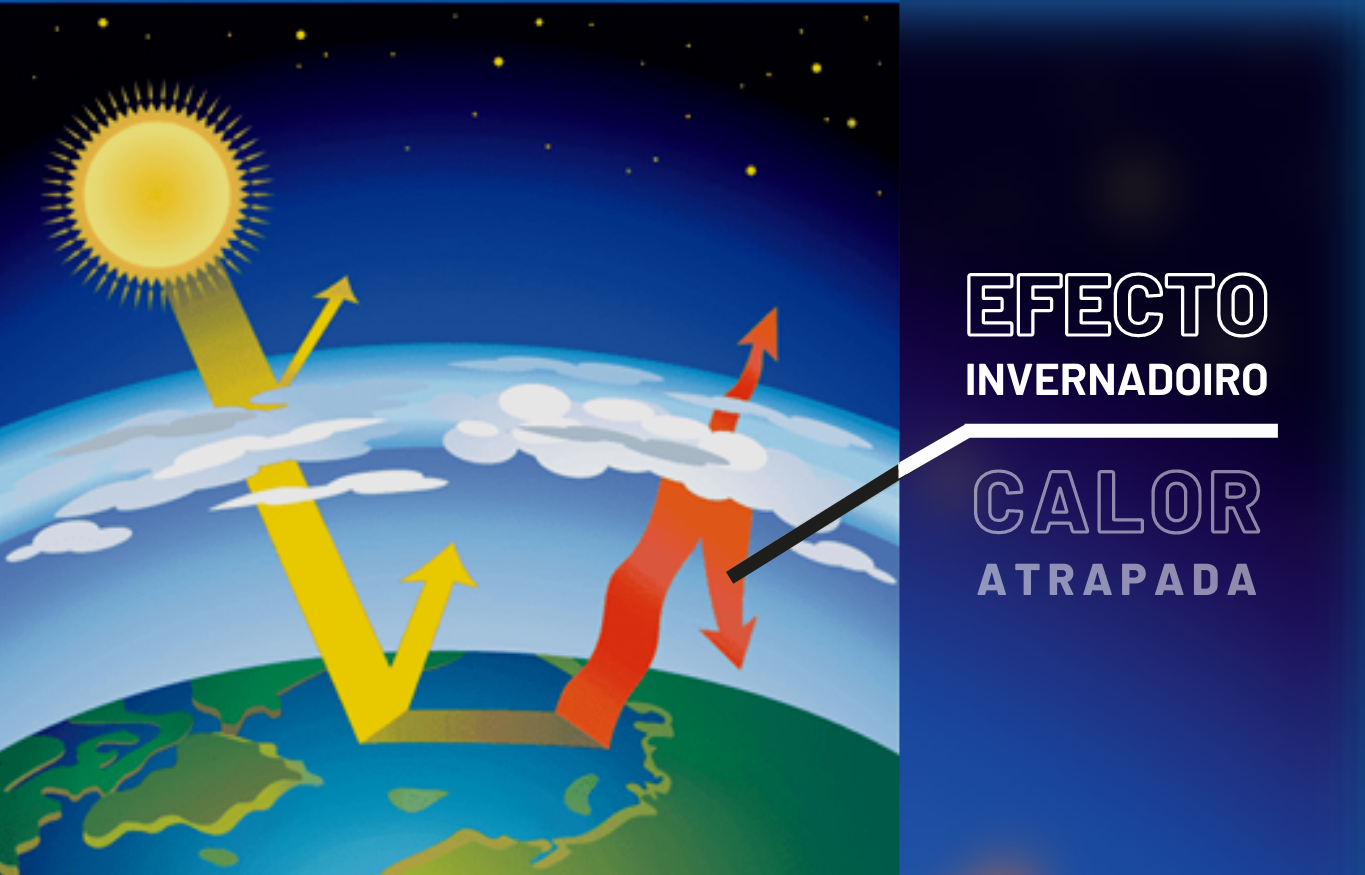
The water vapour and CO2 that Eunice N. Foote described as agents capable of increasing atmospheric temperature are the cause of the greenhouse effect. The Sun emits energy that travels in the form of electromagnetic waves (radiation) towards our planet. Part of the solar radiation (ultraviolet, yellow arrows) is reflected by the atmosphere and by Earth’s surface itself, bouncing back into space, while most of it penetrates through the atmosphere and is absorbed by the land, heating it. Because of this warming, Earth’s surface also emits radiation (thermal or infrared, red arrows) outwards. Part of this infrared radiation passes through the atmosphere and escapes, while another part is retained and re-emitted in all directions by greenhouse-gas molecules in the atmosphere. As a consequence, part of the thermal energy that should escape from Earth returns to the surface (a process known as the greenhouse effect), increasing the planet’s temperature. The higher the greenhouse-gas content, the greater the re-emission of infrared radiation back towards Earth’s surface, progressively increasing the temperature.