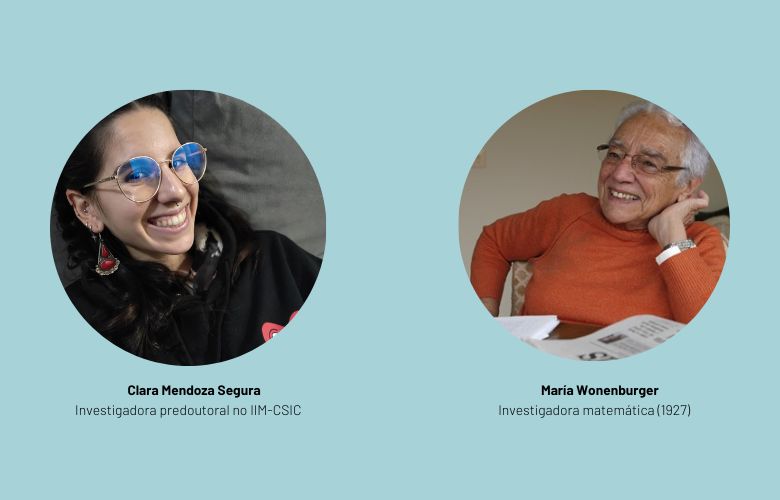


Written by Clara Mendoza, predoctoral researcher in Marine Biochemistry (with Jaime Amaro Blanco).
[Article from the Lanterns of Science II initiative, produced by IIM-CSIC and published today in Faro de Vigo]
Nature is written in mathematics. Recognising the beauty behind the formulas, numbers and equations that define this field of science is difficult for many of us, especially when its complexity goes far beyond the most common numbers and operations.
Most of the time, this field of research comes into the spotlight only when it can be applied: a new astronomical discovery, a new ecological model… Yet, as early as the 1950s, a mathematician from A Coruña was already seeking the beauty of this science in its most abstract corners, far from practical application. After her struggle to reveal the secrets of Algebra, this woman is today regarded as an international reference, although she was forgotten in her own country until only twenty years ago.
María Josefa Wonenburger Planells, born in Montrove (Oleiros) in 1927, understood the study of mathematics as an activity of the mind.
Despite the political situation of the time, she was one of the few fortunate women able to enjoy a complete education. When she finished secondary school in 1944, she wanted to pursue higher studies in Mathematics. This decision was unusual in the society of the dictatorship. Although the law allowed women to study, many abandoned the idea for fear of the social and family rejection they faced because of the roles imposed on them. Women were not expected to study and, if they did, they were expected to choose careers linked to care, such as teaching.
Wonenburger had the privilege of overcoming this unwritten imposition with the support of her family and moved to the Central University of Madrid. At a time when the overwhelming majority of the people around her were men, María always stood out among her classmates. In 1953, after completing her degree in Mathematics, her own lecturers advised her to try her luck abroad and continue her professional career in research.
Following their advice, María achieved one of the many milestones of her life: she became the first woman to receive a Fulbright scholarship in the first call held in Spain. This allowed her to cross the Atlantic to Yale University and complete her thesis entitled “On the Group of Similitudes and its Projective Group” (1957).
The research line she was beginning to develop revolved around Group Theory, Clifford algebra and, a few years later, Lie algebras; concepts whose explanation would fill this entire newspaper and would take many of us back to those secondary-school classes full of matrices and vectors that we struggled to understand.
Unfortunately, being a woman, emigrating and earning a doctorate in another language did not seem to be enough for the Spanish State, which did not recognise her work, supposedly because it had been carried out abroad. Focused on her passion for study, the new doctor did what she knew best and completed a second doctorate, this time at the CSIC’s Jorge Juan Mathematical Institute. To her surprise, her work was rejected again, this time “for bureaucratic reasons”. María was still not considered a doctor in the eyes of her own country.
The limited prospects for research in Spain did not stop María’s career. Thanks to her international prestige, she obtained a postdoctoral fellowship at Queen University in Canada. She then moved to the University of Toronto, where, as the only woman lecturer in the Department of Mathematics, she supervised her first doctoral student, Robert Moody, who surprised her by expressly asking her to be his supervisor, regardless of the fact that she was a woman and an immigrant.
Moody’s thesis became another of the most renowned moments in the life of the Galician mathematician. This work introduced new algebras that were highly relevant in the 1970s and gave rise to scientific advances that continue today. They also laid the foundations of Kac-Moody Theory, essential to quantum mechanics, of which, in Moody’s own words, “María was the mother”.
María Wonenburger’s career moved forward unstoppably, and in 1967 she became a professor at Indiana University (USA).
Unfortunately, her mother fell ill and the scientist returned home to care for her. Her return suddenly ended her academic work and pushed her figure into oblivion for much of society. Even so, her passion for mathematics continued to beat.
It was not until 2002 that two women professors at the University of A Coruña (UDC), María José Souto Salorio and Ana Dorotea Tarrío Tobar, began a long research process that, in 2006, brought María’s figure back into the public eye in her homeland. It all began after they attended a conference to which our protagonist had not been invited.
From then on, national recognition began to arrive for this extraordinary mathematician, then almost 80 years old: honorary member of the Royal Spanish Mathematical Society, first woman scientist to receive an honorary doctorate from the UDC and the namesake of the María Wonenburger Awards of the Xunta de Galiza.
Seen from the present, the life of this double doctor is a good example of the obstacle course that working in science in Spain can be.
While several American universities fought to have her in their departments, Spain did not recognise her work. While she enjoyed high-quality positions in North America, here she had to sit a competitive examination to obtain a post with worse conditions, fewer resources and a lower salary. On top of this, bureaucracy and administrative procedures made it impossible for either of the two doctorates she had earned to be officially recognised.
Many of these problems continue today. They may not be equally intense, but they still often suffocate the vocations and careers of women working in science; they extinguish the enthusiasm of many of us who, day after day, face the overwhelming challenge of trying to develop a personal life alongside a non-precarious professional career in this country.
Being a scientist is difficult, but being a woman scientist is even more so. The decrease in female presence as we move up the academic hierarchy, the so-called “scissors effect”, is an increasingly alarming reality. Even at the start of the research career, where there had traditionally been a certain gender balance, setbacks may be taking place. At the CSIC, the percentage of predoctoral women researchers (50.4%) is the lowest in the last 17 years, according to the Women Researchers Report of the Women and Science Commission (2022).
The trend is worrying. Several reasons are used to explain this phenomenon: the lack of female role models in science, the difficulty of reconciling family life, the burden of care traditionally imposed on women and even the scourge of sexual and workplace harassment.
However, if we want fair, resilient and high-quality science, the conclusion is clear: women must be free to decide without restrictions and to do science on equal terms regardless of their gender. Closing the existing gap in this field is essential if we are to retain female talent, achieve an equal future and provide enough opportunities for women, as María Wonenburger was and as many of us are, to contribute their full potential to society.